
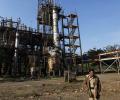
Rediff.com's Prasanna Zore visits ground zero at the Union Carbide plant in Bhopal.

Nearly 900 tonnes of ash generated from the incineration of toxic waste linked to the Bhopal gas tragedy remains undispensed after the Madhya Pradesh High Court directed the state government to find an alternative disposal site.

Madhya Pradesh police have registered five cases against protesters in Pithampur who opposed the planned disposal of 337 tonnes of toxic waste linked to the Bhopal gas tragedy. Protests erupted on Friday after the waste reached Ramky Enviro company, where the incineration is to be carried out. Authorities imposed prohibitory orders, and police dispersed a mob that marched to the company premises. Two people attempted self-immolation during the protests, but were prevented by the crowd. Chief Minister Mohan Yadav said the state government only transported the waste with safety parameters in compliance with court orders.
The Dow Chemical Company, which owns Union Carbide Corporation, on Tuesday said the Indian government had "fully released" UCC and its subsidiary in Bhopal from any civil liability for the 1984 gas tragedy.

If the Bhopal judgment results in independent directors and CEOs/plant managers waking up to their responsibilities, that can only be a good thing.
Just months before the deadly gas leak in Bhopal killed 15,000 people, journalist Rajkumar Keswani -- who passed into the ages on Friday, May 21, 2021 -- had warned that the 'city stood on the edge of a volcano'.

The Supreme Court on Tuesday asked the Centre to clarify its stand on whether it wants to go ahead with its curative petition seeking Rs 7,844 crore as additional funds from successor firms of the US-based Union Carbide Corporation (UCC) for giving compensation to victims of the 1984 Bhopal gas tragedy.

The Union Carbide Corporation gave a compensation of $470 million (Rs 715 crore) after the toxic gas leak from the Union Carbide factory on the intervening night of December 2-3, 1984, killed over 3,000 people and affected 1.02 lakh others.

Twenty-six years after one of the worst industrial disasters, Bhopal Gas Tragedy, which claimed thousands of lives occurred, a local court trying the case would pronounce its verdict on June 7.
NGOs working for the rights of the survivors of the 1984 Bhopal gas disaster on Wednesday alleged that various governments in Madhya Pradesh and at the Centre have failed to bring the culprits of the world's biggest industrial tragedy to justice even after 37 years.
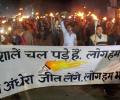
Families of the deceased and people who bore the brunt of the industrial disaster are now signing a petition, to be sent to the Supreme Court, requesting it to start hearing a curative petition of the government filed in December 2010 for more compensation.

Sanjeeb Mukherjee, who was eight years old when the deadly gas leaked from Union Carbide's factory, gives his account of living in the city during that fateful period

Unconscious children being carried by parents in their arms, people laying on roads, health workers scrambling to attend to those affected by the styrene vapour leak and residents fleeing were some of the scenes that played out near Visakhapatnam on Thursday, bringing back grim memories of the 1984 Bhopal gas tragedy.

"We are ready to evaluate purchase for any additional shares including from the IndusInd Bank. But, our headroom is about four per cent. We will keep our holding below 25 per cent," Dabur India Vice Chairman Mohit Burman told PTI from Greece on Sunday.

The change in ownership is expected to give a fresh lease of life to the company that has often been dragged by financial stress in its close to three-decade journey under the Khaitans, reports Ishita Ayan Dutt.

The world had lost an opportunity to know long-term toxic effects of Methyl Isocyanate which had leaked from the Union Carbide factory on the night of December 2, 1984, because government research agencies have lost track of a bulk of survivors, says Dinesh C Sharma.

Saturday will be the last time the Mumbai Mirror will hit newsstands as a daily. Two Saturdays ago, its owners, the Times of India group, shocked the city by deciding to convert the Mirror into a weekly newspaper. Jyoti Punwani salutes the Mirror and its editor, Meenal Baghel, for its pathbreaking journalism.

The debate on the constitutionality of tribunals has not been set to rest as yet, says Gopal Krishna.

Aadhaar-related schemes and the Aadhaar Act exist on the assumption that Right to Privacy is not a Fundamental Right.
